🔎Nike back to 2014 levels?🤯
One of America's most iconic companies is now a restructuring case. Fundamentals don't incite optimism yet. But it's getting interesting from a sentiment perspective.
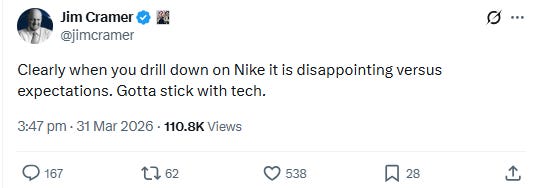
Don’t take my word. Take Jim Cramer’s.
TLDR Summary
Nike is a prime example of the K-shaped economy where AI spenders and their suppliers & shareholders excel while many others struggle. It’s a tough environment for any discretionary consumer stock. Nike is in a particularly tough spot as the company is still in a consolidation phase after the pandemic outlier years.
But the company has also made several strategic mistakes. The pandemic seduced them to heavily bet on DTC distribution which is now backfiring. With true product innovation absent, they are not generating enough website traffic to support their business. They are being taught an expensive lesson: Selling sportswear requires healthy relationships with wholesale distributors. Building back trust with those will take time.
At $45, the stock is now back to where it was in 2014, almost twelve (!) years ago. Can you believe it? The S&P 500 was at just 1,900. It feels like an eternity has passed since then.
From an earnings perspective, the company fully deserves this sell-off. Their EPS is barely higher today than it was back then and a 30x LTM P/E ratio doesn’t make it look like the greatest steal ever.
However, the company’s revenues are 60% higher today than they were in 2014. Nike still has a unique and irreplicable brand with strong athlete relationships and loyal customers. This insulates them from AI disruption and should allow them to eventually convert their revenues into appropriate earnings.
In addition to a potentially successful turnaround, they might also receive cyclical support soon. Consumer discretionary is the most underweighted sector right now. It’s in the middle of a capitulation process. Once that process is complete, the sector could fly just like energy has done recently.
Pandemic boom and post-pandemic bust
Nike stock peaked in November 2021 alongside the top of the pandemic bull market and has been in a downtrend since then. The stock didn’t join the recovery of the broader stock market that started in late 2022.
The company was a classic pandemic darling. Lockdowns caused a fitness wave and people needed sportswear. They also needed comfortable clothing because they worked from home. They had tons of extra disposable income from fiscal stimulus, a disproportionate amount of which was spent on leisure apparel because other forms of discretionary spending were not possible (dining out, travelling, etc). The company also used the pandemic to bet on their online DTC business. Digital distribution was much cheaper than physical retail shops which boosted margins.
Revenues and earnings boomed as a result. In FY22 (which ended in May 2022), they generated $51bn in revenues (up from $39bn in FY19) and an EPS of $3.75 (up from $2.49 in FY19). Markets expected that growth to continue. The LTM P/E ratio was 46x at the stock’s ATH.
That trend continuation didn’t happen. The company struggled with a challenging macro environment and self-inflicted pain.
The K-shaped economy
The 1H22 recession ended unexpectedly and abruptly in 3Q22 when the BEA reported 2.6% real GDP growth. Since then, the US economy has continued to grow at an robust annual growth rate of 2.6%. One would normally assume that consumer discretionary stocks should do fairly well in such an environment.
Obviously they are not doing well at all. Current economic growth is not consumption-driven. Just like during dotcom 25 years ago, it’s investment-driven, probably even more so than back then. In the article below, I estimated that investment in communication equipment likely contributed 50 bps to GDP growth between 1995 and 2001 (ignoring 2nd order effects).
J.P. Morgan estimates that AI-related capital expenditures contributed 110 bps to GDP growth in 1H25. This share will likely increase this year given that hyperscaler capex plans are growing rapidly. It’s quite likely that the ex-AI economy is already in recession.
This investment is clouding the weakness in many other macro segments, especially in industries that are vulnerable to higher interest rates. The AI capex boom raises interest rates and thereby suffocates people who work in real estate, automotive and in discretionary industries in general.
Of course, someone’s spending is someone else’s income, irrespective of whether that spending is capitalized (investment) or not (consumption). When hyperscalers buy GPUs, they create income for everyone involved in shipping, installing and running them. And those who make money from building data centers will then spend their earnings on goods and services from everyone else.
However, it seems that this spillover effect is not happening right now, at least not at a larger scale. That’s why there are so many weak industries. That’s why the unemployment rate keeps rising (very unusual outside of a recession). It seems that consumer spending is heavily driven by a minority right now who are either directly involved in building data centers and/or who have enjoyed stock market gains from AI-related stocks.
Nike is part of the group of AI roadkill. But they have also made several mistakes to make their situation even worse.
Self-inflicted pain
Lacking innovation
Nike has always been famous for their innovation. They have transformed sportswear into a high-tech franchise. Their waffle soles gave birth to modern running shoes in the 1970s. With Nike Air they invented air-cushioned soles in the late 1970s and refined that for decades. The Vaporfly revolutionized road running in the late 2010s. Some of these innovations were commercialized as athlete-branded product platforms and became lifestyle products (Air Jordan for example or Kipchoge’s sub-2h marathon).
Their innovation and the shrewd marketing thereof has made them the most successful sportswear company in the world. The pandemic demand surge came as a windfall gain on top. It seems that this has made the company lazy, or at least complacent. They fell over their own success. In their earnings calls, management has repeatedly articulated their lack of innovation as a core of the diagnosis why they are struggling.
“We need a continuous flow of new product innovation.” (3Q24)
“Traffic in NIKE Direct… have softened because we lack newness in product and we’re not delivering inspiring stories.” (2Q25)
“We haven’t been maximizing these strengths… leveraging… unmatched patented innovation.” (2Q25)
Lack of innovation is not necessarily critical if a robust distribution network is in place. Unfortunately, the company’s push into DTC distribution has nuked that network.
DTC model backfired
DTC appeared like a magic distribution trick during the pandemic. Nike didn’t have to share sale proceeds with distribution partners and enjoyed higher margins. However, this wasn’t sustainable. To generate sales, consumers must actively choose to visit Nike’s website. This requires an extraordinary cadence of product innovation, which Nike didn’t have. In contrast, in wholesale, it’s easier to sell older models/franchises simply through shelf-presence.
So, when the pandemic economy ended and website traffic declined, the company had to deal with distribution challenges and didn’t have a recipe how to deal with those.
“Traffic declines across Nike Direct were more significant than we anticipated.” (1Q25)
“We shifted investments away from creating demand… to capturing the demand through performance marketing for our digital business.” (2Q25)
In addition, Nike’s DTC focus irritated distribution partners. Since their role in distributing Nike products diminished, they prioritized other brands.
“We must lean in with our wholesale partners to elevate our brand and grow the total marketplace.” (3Q24)
“Some partners and channels feel we’ve turned our back on them, and we stopped engaging consistently.” (2Q25)
“Prioritizing NIKE Digital revenue has impacted the health of our marketplaces.” (2Q25)
The company countered these distribution challenges through increased marketing efforts to push inventory into the market. Unfortunately, this made the situation worse by tarnishing the brand.
Brand positioning
Nike’s brand strategy has always been to focus on high performance. Steve Prefontaine, Michael Jordan, Tiger Woods, Lance Armstrong, the Ronaldos, LeBron James. They have always associated with the biggest stars in the most popular sports. When people wanted to look like their stars, they had to wear Nike products. Instead of marketing specific products, Nike marketed a personal brand. Customers seeking to emulate that brand would then indirectly find the products.
Instead of continuing to pursue that strategy, they started to push inventory into the market via promotions, discounts and product marketing. This devalued the brand and hurt their pricing power.
“What I've seen is traffic in NIKE Direct, digital and physical, have softened because we lack newness in product and we're not delivering inspiring stories. The result is we become far too promotional. We've moved to a push model. Entering the year, our digital platforms were delivering roughly a 50-50 split of full price to promotional sales. The level of markdowns not only impacts our brand, but it also disrupts the overall marketplace and the profitability of our partners.” (2Q25)
“We lost our obsession with sport.” (2Q25)
“The level of markdowns not only impacts our brand, but it also disrupts the overall marketplace and the profitability of our partners.” (2Q25)
The company has been working transparently on these issues for about a year. So far, they have not demonstrated meaningful progress. 3Q26 earnings confirm that.
Nike’s 3Q26 earnings
Nike’s revenues were flat in 3Q26 with moderate growth in the US and continued weakness in China.
Margins remain under pressure. 3Q26 EPS was down 35% vs. prior year, 9M26 EPS was down 32%.
They will likely finish the year with $1.90 EPS which is lower than 2015.
Nike continues to disappoint. Management communication doesn’t make it any better. Listening to their 3Q26 analyst call was 62 minutes waste of time. Hard to come up with any quote that is worth sharing with you. A lot of air and buzzwords. Little substance.
To be fair, what can management actually say at this point? At the end of the day this turnaround story is not rocket science. First, they need to rebuild the brand and their original distribution channels. And then they need to pray the consumer comes back.
The fitness industry will continue to grow and people will continue to allocate more of their disposable income to that. I have recently written about that in my piece on Garmin and Strava. Nike is possibly the number one fitness asset out there. They should be able to get their sh** together eventually.
Valuation
Nike stock is down 75% since late 2021. EPS is down 60% which explains much of that. The remainder is a multiple contraction. At 30x LTM P/E the stock is far from being a steal though. Markets expect the company to deliver above average profit growth.
From a valuation perspective, Nike looks best on a revenue multiple. Investors can buy the company today at just 1.4x revenues. I believe a Dollar of Nike revenues is still supremely valuable given their brand and competitive positioning.
Sentiment on consumer discretionary
The K-shaped economy described earlier is also reflected in institutional investors positioning. Discretionary is now the most underweighted sector.
Institutional investors have fled in March which suggests that this is a capitulation in progress. This might soon help the stock to form a bottom. Then it becomes a question whether and when their margins will recover.
Sincerely,
Rene


