

TLDR Summary
Producers sold their production forward. Investors and traders didn’t want to buy that production because they cared more about stocks and crypto. Intermediaries stepped in and bought those futures contracts. They intended to earn only a roll yield from the backwardated term structure. However, they unintentionally assumed some directional exposure through their calendar spreads. Once markets realized the scarcity of physical metal in the spot market, these intermediaries got squeezed.
The current physical shortage is the result of two factors converging. Commercial demand is structurally rising, especially for industrial production. And investor demand is cyclically awakening as part of the Debasement Trade.
The price of silver will most likely come back to earth after this squeeze. However, that process will likely take a while. It’s not really a crowded trade. There is no leverage in long positions. Barely anyone has bought high. Most are looking to enter with shorts. Nobody likes this rally. The path of least resistance is the path of max pain. And max pain seems to be at least some persistency of higher prices.
In my opinion, there are two takeaways from this situation: Firstly, this is not an indictment on our monetary system. It’s rather a risk management failure in a very specific market segment. Secondly, I don’t think anything will break as a result of this squeeze. Yes, it’s a massive short squeeze. But it’s extremely likely that the squeezed shorts are not naked. They have long positions in futures further out which also appreciated in value, thereby negating a large amount of the losses. They won’t have a problem obtaining financing to secure physical silver for delivery. From a macro perspective, silver is not the canary in the coalmine you might be looking for.
The silver squeeze
I looked at gold in more detail in December 2025. I framed it as part of what I call the Debasement Trade 2.0, which is the overwhelming consensus that the value of the US Dollar will continue to decline due to deliberate monetary and fiscal debasement. To protect themselves against this scenario, investors have maneuvered themselves into what I believe to be a dangerous asset overexposure.

Gold is currently in its most powerful bull run ever. It has risen 175% over the last three years. Silver is pumping in its slipstream. In percentage terms, the story is even bigger. It’s up 240% in the last twelve months, 30% in the last month alone. More volatility is likely ahead. By the time you read this, it may be at an entirely different level, impossible to anticipate.
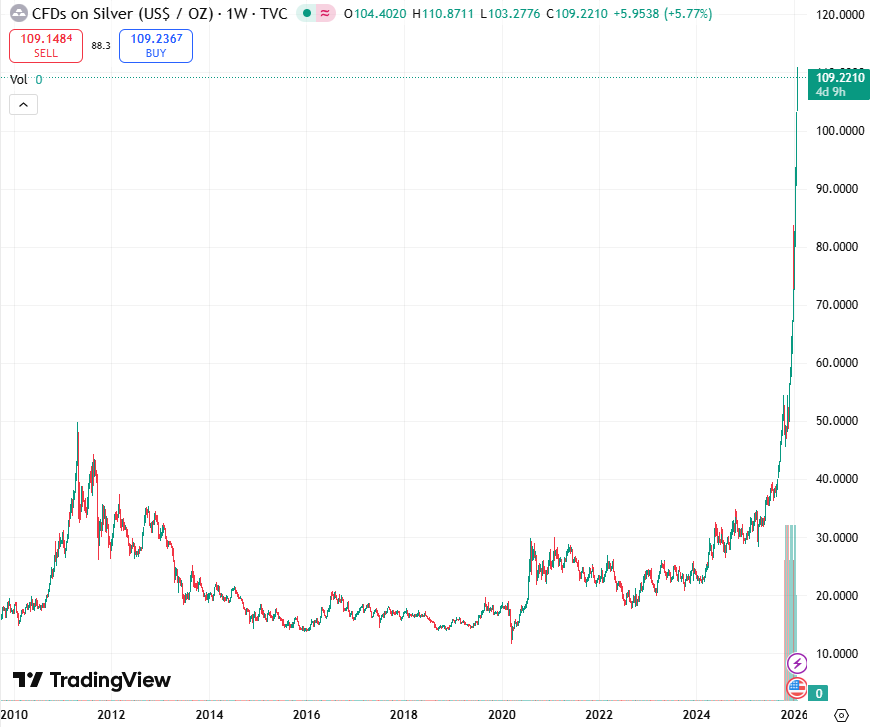
Many observers consider gold and silver as two sides of the same coin. Both assets are performing exceptionally well because trust in our monetary system is at rock bottom and eroding further.
Some of the silver boom is probably part of the Debasement Trade. But there is a more important angle to the story. Charts don’t go vertical like like this because things go right for those betting on the underlying. They go vertical when things go wrong for those betting against it. The chart above looks, smells and sounds like: a short squeeze.
To understand who is being squeezed here and why they are being squeezed, we need to understand some basics of futures trading. Because that’s where the spot price of any commodity is made.
Some basics on futures
If all participants in a market were entirely risk/volatility indifferent, prices would form entirely based on our collective probabilistic estimate of potential outcomes. Having an information or knowledge edge would then be the only way to generate positive returns.
That’s obviously not the case in most markets. There are risk premiums to be earned if you are willing to expose yourself to potential price fluctuations that your counterparty doesn’t want to be exposed to. For example, if you buy S&P 500 shares from me, you are willing to bear its 15% annual volatility and I am not. That’s why you get an 8% annual return and I’m not.
It’s important to understand here that you need no information or knowledge edge against me to earn that return. We both have the same return and risk expectations in this example. Only our appetite for them differs.
If I didn’t have that risk aversion, I wouldn’t sell my shares to you. This would cause a lower supply of shares. The S&P 500 would then rerate higher. If we all were completely risk indifferent, the S&P 500 would rerate higher to a level where the forward return would approximate the risk-free rate.
The same principle applies in futures of commodities and financial underlyings. This principle creates systematic positive returns for buyers or sellers if there is an overhang of counterparties that are willing to enter financially disadvantageous transactions as an expression of their risk aversion.
Here are two examples that I have covered in the past:
