
🔎The truth about the China Shock 2.0.
You will misread the situation if you only care about trade balances. Look at capital balances instead. That's where the story is.

TLDR Summary
China’s exports are booming once again. And this time they are not just producing cheap junk. They are innovating, taking over existing industries and shaping future ones. The media is popularizing this as the China Shock 2.0. This time it isn’t just hurting Western wage earners. It’s also threatening Western asset owners.
Some people argue that this is part of a grand plan of the Chinese government, which subsidizes domestic players in key industries to give them an unfair advantage in international trade. Others argue this just shows the superiority of the Chinese economic model. They are taking over the world because they are simply better. Nothing unfair about that.
Both framings miss the point about what’s primarily going on. This is not a story about Chinese goods conquering the world as much as it’s about capital pouring into the US. America’s giant appetite for capital is forcing the rest of the world into a trade surplus with them. China gets a disproportionate share of that surplus since most of their industries are leading their fields.
It’s a mistake to believe the CCP wants any of this. Of course, they like their domestic companies to be successful internationally. But they don’t need any more claims on foreign assets. What they need is more domestic consumption and investment. More domestic credit demand to get out of their deflation spiral. They probably won’t get that as long as the world wants US assets and as long as the US wants that foreign capital. The hegemon will decide what’s next.
From China Shock 1.0…
Beginning in the early 1990s, China started leveraging its huge workforce to develop its famous export-oriented economic model. This accelerated after the country got admitted to the WTO in 2001. By 2007, its annual trade surplus had reached more than $300bn, almost 9% of GDP.
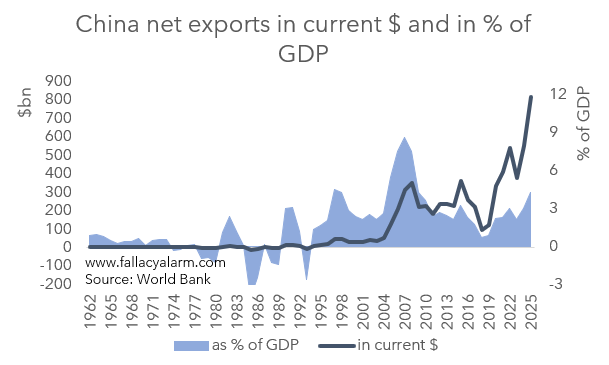
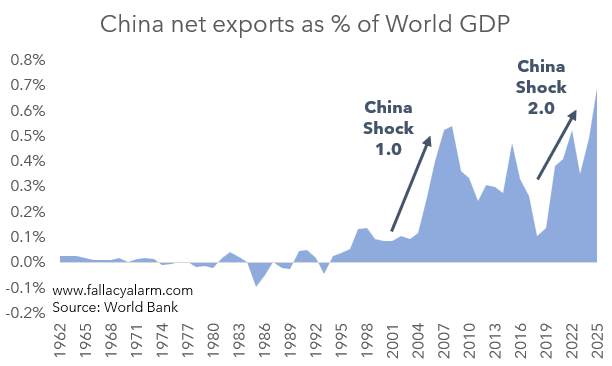
This export boom was a great economic success that lifted hundreds of millions of Chinese out of poverty. For much of the rest of the world it was a shock though. When measured as a % of World GDP, the Chinese trade surplus went from nothing to 0.6% in just over a decade. Tons of production processes were outsourced to China, esp. labor intensive ones in the textile industry, in furniture making, in electronics assembly, in toys and sporting goods and household appliances. The media popularized this phenomenon as the China Shock.
Western consumers appreciated having access to cheap goods from China. Asset owners enjoyed higher profits from using Chinese labor. But Western labor markets got under pressure as an inconvenient side effect. Inequality surged as a result with all its political consequences that we are still witnessing today.
The China Shock abated somewhat after the GFC. Western consumers were deleveraging which lowered demand for Chinese products. There was also pressure on supply because wages were rising rapidly in China. Chinese people started consuming and investing more domestically which led to excesses in the stock market and the housing market, the aftermath of which led to economic pain.

For a while it appeared as if the Chinese export model had hit a limit and the steep trade imbalances of the past would not return. The trade surplus fell to just $90bn in 2018, which was just 0.6% of Chinese GDP and 0.1% of World GDP. By the time Trump started the first trade war, the problem he was trying to solve barely existed anymore.

…to China Shock 2.0.
But then something curious happened, the start of which coincided with the 2020 pandemic: The Chinese trade surplus surged again. By 2022, it reached $540bn (+500% vs. 2018). Initially it seemed as if this was an outlier from the pandemic stimulus. But it didn’t stop even as Western fiscal deficits (somewhat) normalized. In 2025, China’s trade surplus even reached $820bn.
And the quality of these exports is even more important than the quantity. This time China isn’t just producing cheap junk anymore or copycats of Western brands. They are innovating at a breakneck pace, thereby ruining entire industries in the West that used to carry entire countries.
For example, China barely exported any cars before 2021. Now, they are exporting a million units per month. It took them just a few years to unseat Germany as the world’s largest automotive supplier.
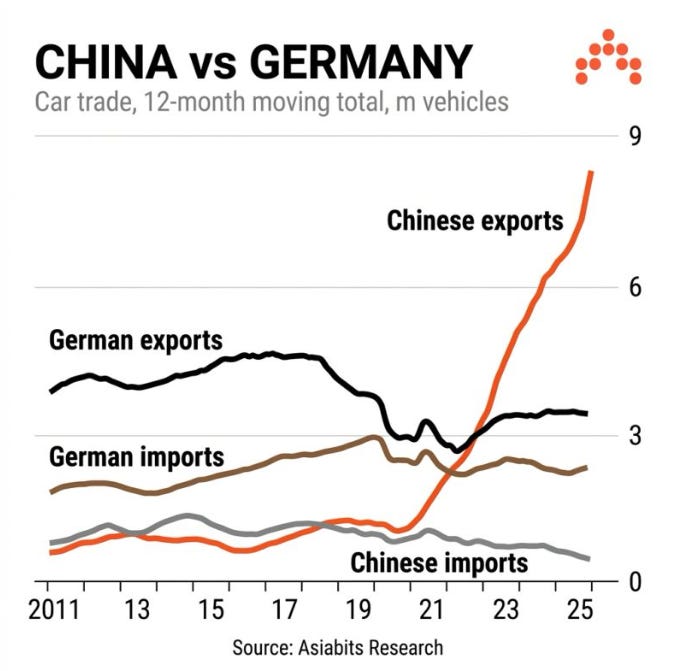
BYD has already become the world’s largest EV manufacturer and will soon likely become the largest vehicle manufacturer of any kind.

But they are not only taking over existing industries such as automotive. They are also shaping future industries, most importantly in LLMs, autonomous driving and humanoid robots. For example, Unitree is the largest humanoid manufacturer globally and other Chinese tech companies have promising models in development as well.

All of this seems like China is winning big time. But that is a misread of the situation. The truth is:
China doesn’t want this.
At least not at the current extreme scale. Of course, they want their companies to be successful internationally. But they don’t want that to cause huge trade surpluses indefinitely.
Do you think the Chinese are happy with the massive undervaluation of their currency which makes them sell their labor to the rest of the world at a discount? Do you think they are happy with the underwhelming performance of their stock market and their ever falling GDP growth rates? Do you think they are happy with their depressed housing market or their high youth unemployment?
To secure its power, the CCP must drive domestic consumption and investment. Chinese people will only continue to accept political oppression if the party can continue to promise wealth gains. Running ever higher trade surpluses is not suitable for that goal. They drain the country of capital needed to achieve sustained economic growth for the benefit of sufficiently many citizens.
That’s why the Chinese government has worked on fixing trade imbalances for quite a while. The most important evidence is their FX policy. For at least the last ten years they have worked on supporting the Yuan rather than weakening it. Their UST holdings are falling. Their FX reserves generally are falling. Instead of accumulating foreign assets, the PBoC is lending domestically in an attempt to boost domestic consumption and investment. I have written about that in more detail in the article below.

They would probably dispose of their FX reserves even faster if they weren’t concerned about monetary consequences. Liquidating FX reserves is a deflationary move because it destroys domestic currency. Inflation is currently only 1.0% in China. They can’t afford it to go even lower. Realistically, they can only liquidate FX reserves to the extent that they can drive additional domestic borrowing.
Why the US is the real driver of international financial flows?
A few months ago, I wrote the article below, articulating my take on what’s American Exceptionalism and how it has evolved over time. Today, more than ever, capital is America’s main motivation to lead the world.

The US accounts for 4% of the world population, 15% of world GDP at purchasing power parity and more than 50% of global equity market capitalization.
Its entire political system is built on attracting an ever higher amount of capital from abroad. It’s like oxygen for the US economy. It keeps their currency strong in spite of massive trade deficits and massive fiscal deficits. It enables massive transfer payments via the US Treasury to keep the masses calm. It allows Americans to buy stuff from China and elsewhere cheap. It props up the investment accounts of Americans and makes them happy voters. 62% of American own stocks, a much higher share than in many other countries. The equivalent share in Germany is less than 20%. 65% of Americans own real estate. The American Dream is not just owning a home. It’s also owning the S&P 500.
Anyone looking to build or retain political power in the country must try to leverage the foreign bid into domestic assets. And the harder the political frontlines become, the more politicians will be incentivized to push this further. The rest of the world then becomes collateral damage of the fight between Republicans and Democrats.
That’s why every single foreign policy decision of the US is driven by the desire to attract more capital from abroad. The flipside of that can be observed in rising trade deficits. Let their leaders talk all they want about wanting to fix trade imbalances. Their actions speak louder than words. They want these deficits to persist. They are very convenient for those in power. They have made them rich.

The China Shock is really rather an America Shock. America gets everyone’s capital to keep growing and dominate the world, the rest of which becomes slaves in its empire.
What’s the point though?
After reading all of this, you might respond: So what? Who cares whether the China Shock is really an America Shock? What does it matter if the current trade imbalances are the result of deliberate Chinese government policy, of superior innovation in China or of American appetite for capital? At the end of the day, you can’t prove any of this anyway. It remains a question of belief and framing.
I’m here to assert that this distinction actually is important. Because nearly everything noteworthy happening out there can be tied back to America’s incredible run. Their fiscal deficits. Their trade deficits. Their corporate capex party. Their trade wars. Their actual wars. Their interest rates. Their political polarization. The valuation of their currency. It’s all the same theme. It’s all the same trade. This is America’s world. We just happen to live in it.
If (when?) this ever falters, it will do it all at the same time. It will not just end with falling fiscal deficits or falling trade deficits or falling corporate investments or political turmoil or US Dollar depreciation. It will end with all of these things together.
So, when you look at China, you are actually looking at another facette of American Exceptionalism. If the Yuan ever starts appreciating against the US Dollar and if China ever receives a substantial share of international capital flows, that might be part of the unraveling the American SuperCycle. Originally I called it the Fed SuperCycle. I now understand this as a much broader theme.

Sincerely,
Rene