
🔎Guardant Health: Innovation in cancer screening.
The future of oncology is widespread screening for early detection, even for younger age groups. Guardant's approach for colorectal cancer is a blueprint for more. Their operating momentum is huge!

Sick of GenAI? Believe it or not, there is commercially impactful innovation in other places as well. Fallacy Alarm exists to find that for you. I hope you will enjoy reading the below just as much as I did writing it.
TLDR Summary
What do the actors Chadwick Boseman, Kirstie Alley and James Van Der Beek have in common? They died in the last few years from colorectal cancer at relatively young ages. This is anecdotal evidence of a larger trend. While the incidence of this form of cancer is declining for older patients, younger age groups are actually experiencing rising incidences. In some countries rapidly.
We don’t know exactly why this is happening. It could be the more sedentary lifestyle of younger generations. It could be that they are more exposed to environmental toxins. But changing food consumption is the most likely culprit in my opinion. In contrast to previous generations, younger age groups have consumed lots of processed food and very little fiber for most of their lives. This has possibly contributed to an underdeveloped gut microbiome which promotes cancer formation.
Whatever is driving the rise of colorectal cancer, it’s probably not reversing course anytime soon. The good thing is: If it’s diagnosed early enough, the patient’s prognosis is actually quite good. There are even preventative procedures. Colorectal cancer is less lethal than mass killers like pancreatic or lung cancer. Hence, in order to beat it, we will need to ramp up screening.
Since colorectal cancer is still primarily associated with older age patients, there is no widespread screening among younger cohorts yet. It’s needs to be rolled out. That roll-out is precisely the opportunity for Guardant Health. The company is currently in the early innings of ramping its innovative blood-based cancer screening. If they do that well, they have a chance of making this a high-margin multibillion Dollar franchise that may serve as a blueprint for screening in other indications, even beyond cancer.
The current operating momentum of the business is enormous as evidenced in their latest quarterly results. This is very encouraging signal that suggests that the company sits on a powerful technology.
Related content from Fallacy Alarm


Colorectal cancer is on the rise among younger adults.
When a well-known person dies at a relatively young age, I’m often curious about the cause of their death. I want to know what’s killing the wealthiest people early, hoping that such anecdotal evidence helps me build awareness for health risks for me and my family.
My takeaways from that routine are usually quite mundane: Avoid dangerous activities and take care of your mind, i.e. avoid excessive stress and substance abuse for example. But a quite eerie observation has crept in as well. Surprisingly often the cause of death is a disease that I have previously associated with old age: colorectal cancer.
About two million people get diagnosed with colorectal cancer every year and about one million people are dying from it every year. That makes it the third most common form of cancer worldwide. With a median age at diagnosis of about 66-67 years, colorectal cancer is indeed a form of cancer that typically occurs later in life. Younger people usually get other forms of cancer (breast, testicular, cervical etc.).
And then there are news like this:
Chadwick Boseman died from colorectal cancer in 2020, aged 43
Kirstie Alley died from colorectal cancer in 2022, aged 71
Nick Lloyd Webber died from colorectal cancer in 2023, aged 43
Salvatore Schillaci died from colorectal cancer in 2024, aged 59
Ben Lewis died from colorectal cancer in 2025, aged 46
James Van Der Beek died from colorectal cancer in 2026, aged 48
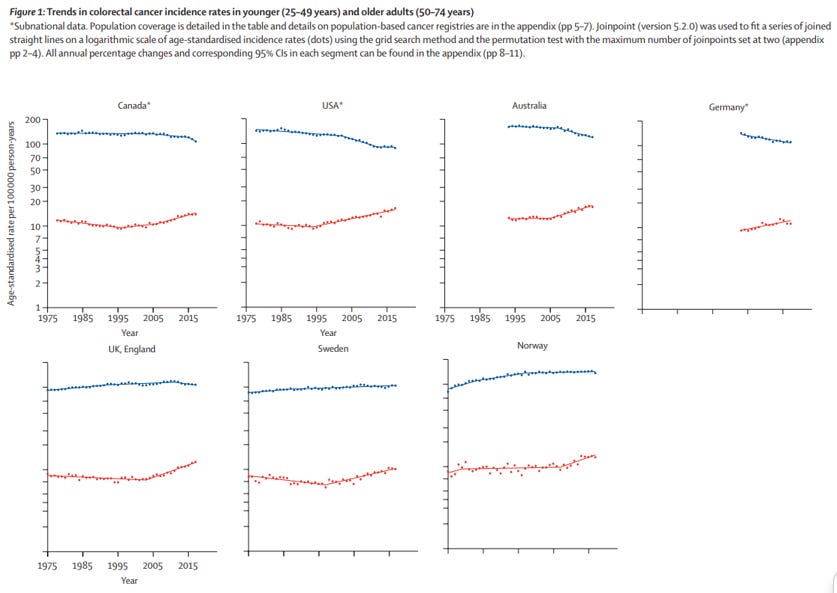
It seems like colorectal cancer is becoming a significant health risk for younger patients. The data corroborate these anecdotes. While the incidence of colorectal cancer among older patients has been flat to moderately falling over the last ten years, it has been rising in younger cohorts in many places. The statistically most significant divergences are happening in North America (US, Canada), Australia and parts of Europe (Germany, UK, Scandinavia). The charts below have a log scale which somewhat understates how rapidly the incidence of colorectal cancer at younger cohorts is rising in some countries.
Why is that so?
While there is no final scientific conclusion yet on the reasons for the surge of colorectal cancer in younger age groups, there are several theories. To understand these, it’s helpful to first clarify how exactly the colon works and what it’s needed for.
