
🔎Is Europe sleepwalking into World War III?
There is currently no path to resolve the Ukraine war through negotiation. Further escalation seems inevitable. Don't be surprised if there will be military action outside of Ukraine and Russia soon.

TLDR Summary
The most useful way to think about the current war in eastern Europe is not to frame it as a confrontation between Ukraine and Russia, but between the EU and Russia. And since Germany is the leading country in the EU, it’s ultimately a confrontation between Germany and Russia. These two have repeatedly clashed for hundreds of years. And every time, this has caused devastation for the entire continent and beyond. They are the deadliest neighbors on this planet.
The West views Ukraine as a sovereign country which (like any other country) can freely choose who to partner with. Russia understands NATO as a military organization that was created with the sole purpose of antagonizing them. To lay down its arms, Ukraine demands permanent Western military presence, the prevention of which is the whole point of Russia’s campaign.
The conflict keeps escalating with no negotiation solution in sight. Unrestrained by its Western allies, Ukraine keeps provoking the world’s strongest nuclear power with deep strikes. Eventually, this will lead to retaliation. Russia will strike Western targets outside of Ukraine. Then hell will break loose on the entire continent.
Germany’s role is the most puzzling aspect of this conflict. It has little to gain from its loyalty to the Ukrainian regime. Yet, its political and media elites are Ukraine’s staunchest supporters. This support only makes sense once you understand that Germany is currently in economic and cultural decline which will trigger political unrest as various groups will fight for what’s left of the economic pie.
In response to domestic crises, German elites will manufacture internal and external enemies to defend their position. Conveniently, this will also patch concrete economic issues. German industrial capacity is idling as its core industries are being outcompeted by China. The most realistic way to reactivate that capacity is to use it for military purposes. Make tanks, not cars. It has happened before. The best way to hedge World War III may be to buy Volkswagen shares.
Related content from Fallacy Alarm


The power of the unexpected
What has shaped the path of our civilization most in the last hundred years? If you’re into politics, you might argue it’s the outbreaks of the two world wars. If you’re into technology, you might point to the computer and the internet. If you’re into demography, you might say it’s the birth control pill.
Most potential answers have one thing in common: they were events that changed trends or ignited new ones. History is shaped by unexpected turning points way more than it’s shaped by continuation of trends that most people understand well. We overestimate evolution and underestimate revolution. ‘Nothing ever happens‘ is a trader mindset that badly backfires over longer time horizons.


Nassim Nicholas Taleb popularized this idea when he wrote The Black Swan twenty years ago. He defined a Black Swan as a highly unexpected event with enormous impact which people then rationalize after the fact.
In September 2024, I wrote the article below, where I argued that all stock market drawdowns of the last one hundred years can be traced back to six distinct risk categories which caused unexpected shocks.

One of those categories is Violence. We haven’t had a major market drawdown due to violence in more than eighty years. Therefore, it isn’t front and center on the investor risk radar anymore. There is always some subtle risk of World War III. But nobody assigns serious odds to it.
I believe the Ukraine situation has the potential to catch all of us wrongfooted. We are currently sleepwalking into making large parts of Europe a war hotspot once again. Germans can’t fathom another destruction of their homeland. But Ukrainians and Syrians couldn’t either.
No way out through negotiation
The West views Ukraine as a sovereign country which (like any other country) is free to partner with whatever country or group of countries it pleases. Russia’s interference with Ukraine’s foreign policy is therefore viewed as unrighteous.
Russia understands NATO as a military organization that was created for the sole purpose of antagonizing Russia. They also don’t look at countries at the individual level. They rather divide the world in blocks.
The strongest political block in the world is led by the US obviously. The US charges a high price for its leadership. It demands full economic and cultural submission from its allies. Any country joining the US block will eventually also deal with social phenomena originating from the US zeitgeist. It’s important to understand that when countries like Russia or China reject US hegemony, they are doing so in part to keep wokism outside of their borders for example.
Therefore, Ukraine is not an independent sovereign country from Russia’s perspective. It’s a member of a block that is either friendly or hostile. Russia will never accept permanent Western military presence in Ukraine.
There is really no way out of this conflict through negotiation. To lay down their arms, Ukrainians will demand Western protection, the prevention of which is the whole point of Russia’s campaign.
No way out through military means
When a negotiation path to peace doesn’t exist, there might still be a military path of course. One party could simply win to dictate the terms of the subsequent peace. It’s hard to get any objective intelligence from the frontlines. Any information that gets out is heavily distorted by propaganda on both sides. But since frontlines haven’t moved much in more than four years, I believe it’s safe to say that both parties are likely in a stalemate situation.
Drones seem to have become the biggest obstacle for the success of a military offense. They are very cheap and very effective in hurting the enemy’s advancing equipment. They have made defense much stronger just like the machine gun did in World War I and caused years of frozen frontlines on the Western Front.
The Russian-Ukrainian war is a war of attrition that will only end once one of the parties runs out of the financial or mental resources to continue. Ukraine won’t run out of anything anytime soon. They have powerful financial support from Western allies. Just earlier this year, the EU has approved a new package which will provide €90bn to cover this year and next year.
And Russia seems to be fine funding this war via oil and gas exports which generate about $200bn annually. The ruble doesn’t indicate significant macro stress so far. Putin’s approval ratings also seem to remain fairly strong. I doubt he will eventually be replaced by someone with more willingness to give up on Ukraine. A full regime change would likely be needed to make Russia stop its Ukrainian campaign. Trying that on the worlds’ strongest nuclear power would obviously be insane.
Irresponsible deep strikes
As the war progresses, Ukraine is more and more striking targets deep in Russian territory, often in Greater Moscow. These strikes are the core of the current escalation spiral.
Some people argue this is only fair. Since Russia is operating on Ukrainian soil, Ukraine should be allowed to operate on Russian soil as well.
Let me be very clear about this line of thinking: It’s incredibly infantile. What’s fair and just matters in child raising. It doesn’t matter for decision making in a war. A war only cares about incentives, interests and positions. There is only one criterion for every decision: If I do X, then the enemy will likely do Y. Do I want my enemy to do Y? Can I live with my enemy doing Y?
Deep strikes will most likely not break the Russian morale. Instead, they will increase the Russian willingness for aggression. These strikes are insulting Russians who are of the opinion that they have held back in this conflict so far. Deep strikes will likely rally the Russian people even more behind Putin and political hardliners generally. These strikes increase the likelihood of Russian strikes beyond Ukrainian borders.
And what are we going to do when Russian missiles start hitting Warsaw and Riga? The narrative of the past few years will force us to frame it as another step of Russian imperialism which has to be retaliated again. Even more weapons. Even more mobilization. And what is the end game supposed to look like? Do Europeans really want to take Moscow? The capital city of a country with more than 5,000 nuclear warheads?
If European leaders were responsible, they would tie financial and military support for Ukraine to the condition of not striking on Russian territory. We help you to defend yourself against an unjust invasion, but we take the steps to keep harm from our own population. It would be a minimum concession to Russia to at least signal some willingness to keep this conflict under control.
European leaders are not doing that, of course. Their minds are in ashes from the ideological fire that has been burning in their heads for too long.
Germany’s motivation
It’s easy to steelman Ukraine’s motivation. They seek partnership with the West to enjoy the prosperity that comes with it. It’s also easy to steelman Russia’s motivation. They don’t want another NATO member at their border, just 500km from Moscow. But what on earth is driving the warmongering in Germany, the political and media elites of which are the fiercest Ukraine supporters of all?
To some extent, this unconditional loyalty reminds of the ‘blank cheque’ that Wilhelm issued to Austria-Hungary in 1914. When Serbian nationalists killed Franz Ferdinand, Austria-Hungary wanted to punish Serbia. It was a local conflict that didn’t need to become a major war. It only did so because Serbia was under Russian protection and because Germany assured Austria-Hungary of full support. They sleepwalked into World War I just like they might be doing it with World War III right now.
Of all stakeholders, Germany should actually be the country most interested in a solution through negotiation. Its entire economic model depends on its partnership with Russia and access to its natural gas. Being cut off from that has accelerated Germany’s deindustrialization in the last few years.
Also, every German should know from history that nothing good can be downstream from fighting with Russia. Napoleon learned it the hard way, just like Wilhelm and Hitler did later.
What is there even to gain from defending Ukraine? Germany has no economic interest in Ukraine. In contrast to the US (which ties support to getting infrastructure and natural resource deals), Germany’s support for Ukraine is pure donation. Yes, the payments are technically loans. But there is no collateral and hence Ukraine will likely never be able to pay them back.
Some people argue that supporting Ukraine is crucial to avoid further imperialistic Russian attacks in Eastern Europe. I find that far fetched since the Russian aggression wasn’t proactive. It was a reaction to Ukraine’s attempt to join NATO and EU. German support for Ukraine is purely altruistic. At least it’s genuine in that. But it also seems completely irrational? Is there any way to explain it rationally?
To attempt such a rational explanation, it’s important to understand that Germany is currently in a period of economic and cultural decline. I have written about that in great detail in various articles, some of them linked above in the intro.
The country’s prospects are bleak. It’s facing the steepest demographic cliff of all major developed nations. A nonsensical immigration policy is unsuitable to address that cliff and will in fact burden the social welfare system even more. The education system is collapsing as collateral damage from that immigration policy. Core industries are being outcompeted by China. The Euro has been draining the country financially and has disincentivized important innovation via currency suppression. A nonsensical energy policy is accelerating the country’s deindustrialization.

Spirits are low as a result of this decline. National pride is generally not the Germans’ greatest forte. The current crisis is destroying what’s left of it. The economic malaise will also cause a significant drop in the standard of living. Political unrest will then arise as various groups will fight for what’s left of the economic pie.
As a response to that, elites will manufacture internal and external enemies to defend their position. Internally, they are already working on banning the leading opposition party or at least its major representatives. Various legislation efforts are directed at censoring and demonizing critical media.
Externally, Putin serves as the ideal enemy to rally against. He’s a distraction from the domestic corruption and mismanagement. If nothing is left of what made Germany strong after World War II, at least people can pat each other on the back for being the good guys, defending rebels against an overpowering empire.
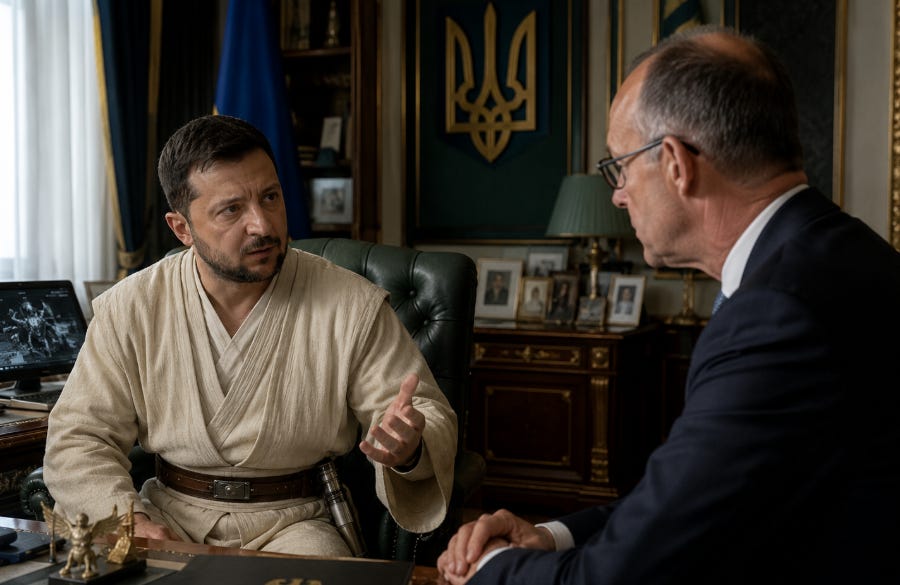
And conveniently, a military confrontation with Russia also patches concrete economic issues. By 2029, Germany plans to spend more than €150bn annually on defense, up more than 200% from 2021. Chancellor Merz has repeatedly said that he wants to build ‘the strongest conventional army in Europe’.
Quite frankly, this goal freaks me out. His gang is on the wrong side in every decision they make. The more levers you give them, the more destructive they will be. It has given me comfort that they haven’t had any real military power so far. I really don’t want to find out what they will do with an actual army ready for combat.
I can imagine that defense budgets will be increased further should the war with Russia escalate further. Eventually, idle automotive factories will be repurposed into tank factories. The best way to hedge World War III may be to buy Volkswagen shares.
Sincerely,
Rene