
🔎adidas: Supershoe = Superstock?🏃
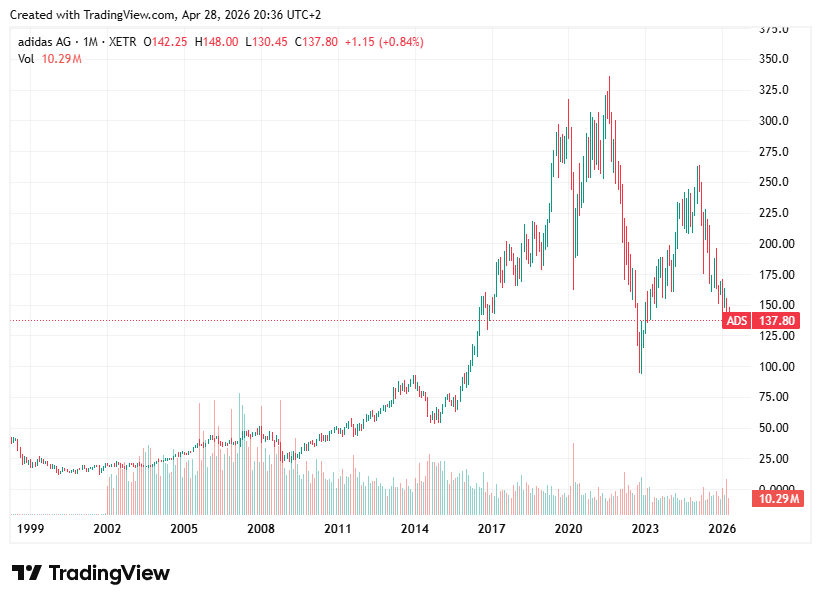
Nike stock tripled when it dominated road running the way adidas is dominating right now. Yet adidas gets no love from investors. Its stock is trading below the pandemic bottom and it keeps falling.

TLDR Summary
If you want to sell branded products, you need to get your customers excited. Nike’s reinvention of road running shoes in the late 2010s is a perfect example. After Eliud Kipchoge won the 2017 Berlin Marathon in the freshly launched Vaporfly 4%, its stock ran more than 200% over several years. And then it topped shortly after Nike’s shoe dominance ended in the fall of 2021.
With Sebastian Sawe’s recent world record at the 2026 London Marathon, adidas has reached a level of dominance that is reminiscent of Nike’s standing in the late 2010s. They have now won 9 out of the last 16 marathon majors whereas Nike has just won 3. 4 out of the 5 top finishers at the 2026 London Marathon wore adidas’ new Adizero Adios Pro Evo 3, a prototype shoe, the commercial version of which was conveniently launched commercially just a day after the event.
adidas stock has not reflected any possible upside from this dominance yet. It’s currently trading significantly below the pandemic low of March 2020 and remains in a firm downtrend.
As a hobby athlete and as a sports fan, it makes me sad that running shoes seem to matter more than athletes these days. But as an investor, I’m getting curious. Is Mr. Market neglecting a bigger story here?
More similar content from Fallacy Alarm


Nike launched the era of supershoes.
Shoe technology has always mattered somewhat in professional running. But its importance skyrocketed at the 2016 Summer Olympics when the top three finishers in the men’s marathon all wore early prototypes of the Nike Vaporfly 4%. The shoe was commercially released in July 2017 and the first marathon major won with this shoe was the Berlin Marathon in September 2017.
What made this shoe special was its full-length carbon plate which made it stiffer and thereby increased the lever for the athlete to push off the ground, giving him a distinct advantage over his competitors.
But the carbon plate wasn’t just a game changer because of the improved leverage. It also gave the shoe sufficient stability to equip it with very thick and very soft foam to bounce the athlete of the ground. Nike (and later other manufacturers) euphemistically refer to this as “energy return”. In reality, they are simply putting springs on the feet of their athletes. The idea behind this is in principle no different from wearing rollerblades. Those also return your energy, are they not?
Nike started to dominate the world marathon majors for years. It took a while for other manufacturers to develop their own supershoes.
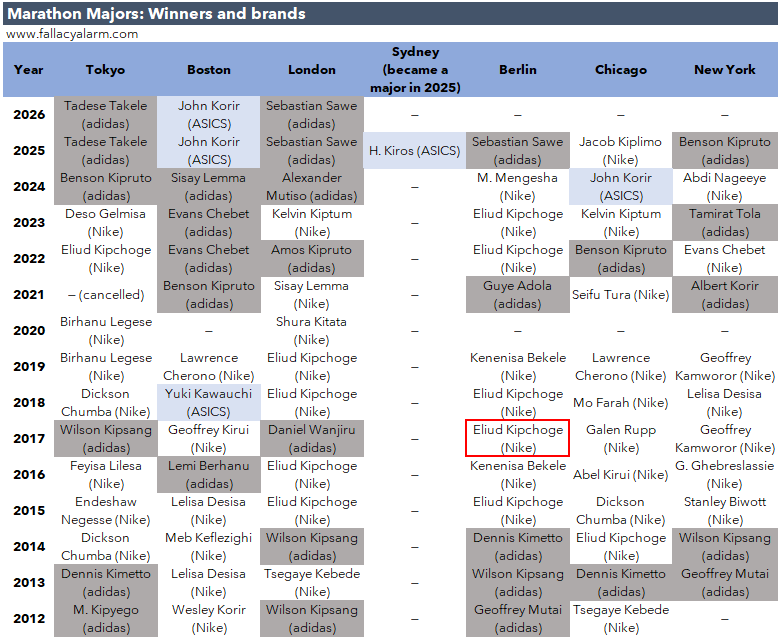
With the exception of the Boston Marathon in 2018 (‘citizen runner’ Yuki Kawauchi upset the running community with a surprise victory), it took almost four years until another brand celebrated a victory: adidas athlete Benson Kipruto won the Boston Marathon in 2021. That marked the day when Nike’s dominance ended. Over the last year, they have just won one marathon major, the Chicago Marathon in 2025.
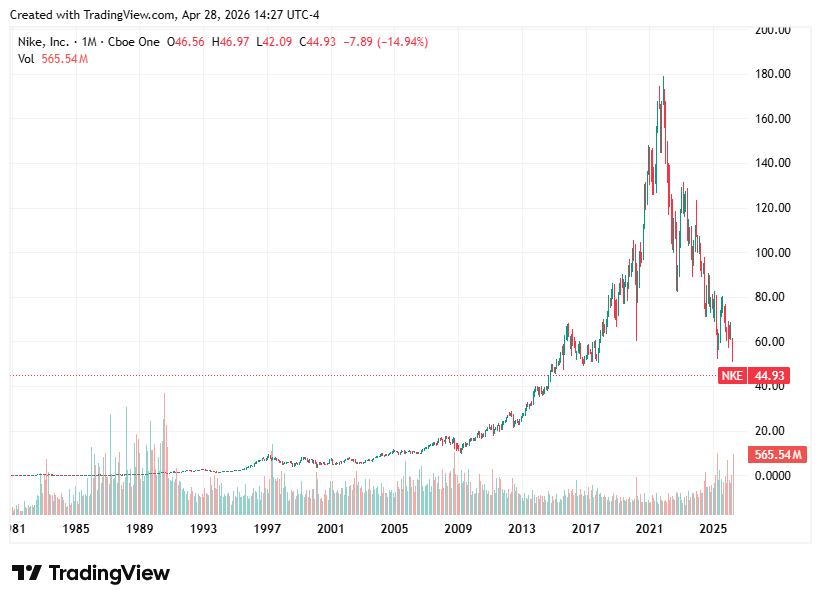
Nike stock reflects the rise and fall of their running shoe dominance. It ran 200% between Kipchoge’s Berlin run in 2017 and Kipruto’s Boston run in 2021. In fact, it’s crazy how well the bull run of the stock aligns with those two dates. The stock broke out of its consolidation almost exactly at the time of Kipchoge’s Berlin 2017 performance and the 2021 top happened just one month after the Boston Marathon of that year.
And then adidas took over.
Since then, adidas has quietly reached a dominating position. As of today, they have won 9 out of the last 16 majors.
Their dominance reached another level last weekend. On April 26, Sebastian Sawe set a new world record in adidas shoes. As the first athlete ever, he finished a race in less than two hours. He improved the standing world record by more than one minute. The second finisher, Yomif Kejelcha, and the third finisher, Jacob Kiplimo, stayed below the previous world record as well. 4 of the top 5 finishers wore the Adizero Adios Pro Evo 3 supershoe.
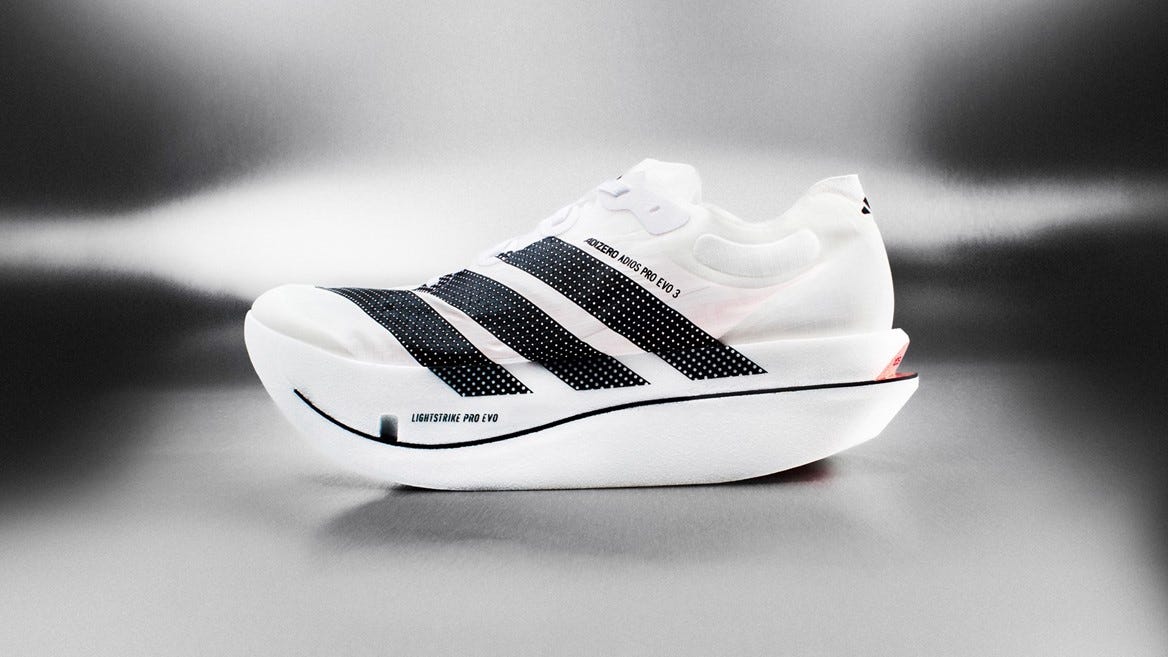
adidas is particularly proud of the shoe’s weight and its ‘energy return’. The springs are getting stronger.
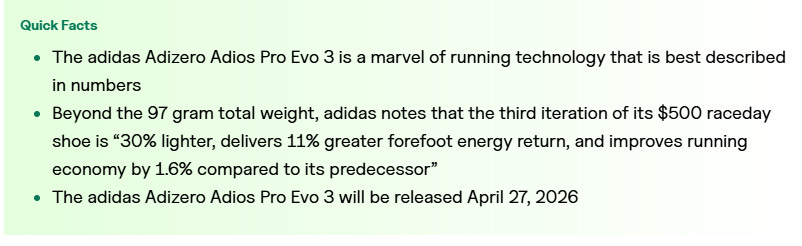
Conveniently, this shoe was released for the general public on April 27, just one day after the race. For just $500, every ambitious hobby athlete can now feel like a pro. And since these shoes are typically toast after just 200km, it will be expensive for them (and lucrative for adidas) to maintain that feeling.
The commercial consequences of such an earthquake should not be underestimated. Running is the most popular sport in the world. There are more than 600 million people in the world who regularly run. The link between athlete performance and individual purchase decision is nowhere as close as in running. The global running shoe market is worth about $50bn. And once people like a brand, they will likely buy leisure shoes and clothing from that brand as well. A supershoe is a superhook.
Interestingly, adidas stock has not yet priced in any positive effect from this. It has shown absolutely zero reaction after last weekend. It’s trading below its pandemic bottom from March 2020. Its market cap is approximately a third of Nike’s while its revenues are about half.
As a hobby athlete and as a sports fan, it makes me sad that running shoes seem to matter more than athletes these days. But as an investor, I’m getting curious. Is Mr. Market neglecting a bigger story here?
Sincerely,
Rene